
The Australian digital marketing landscape has a dirty little secret: most agencies burning cash on local hires are losing to competitors who figured out the economics game years ago.
Here’s what changed. A decade ago, white label services were the industry’s worst-kept secret—something agencies whispered about but rarely admitted to using. Fast forward to 2025, and the conversation has completely flipped. The agencies still pretending they do everything in-house aren’t being noble. They’re being inefficient.
The Old Playbook Is Broken
The traditional agency model looked something like this: hire a full-time team, pay market-rate salaries, throw in the office perks, cross fingers that utilisation rates stay above 70%, and hope clients don’t churn before the hire pays for itself.
The math stopped working around 2019. Not because the talent got worse, but because the cost structure became unsustainable for all but the largest players. A mid-level SEO specialist runs $80K–$100K annually when you factor in everything—salary, benefits, office space, training, and the inevitable downtime between projects.
Meanwhile, client expectations kept climbing. More channels. Faster turnarounds. Better reporting. The same budget.
What Actually Changed With White-Label Digital Marketing
The evolution wasn’t technological—it was philosophical.
Early white label agency models were just outsourcing with better branding. Farm out the work, slap your logo on it, hope the client never asks questions. That worked until it didn’t, usually spectacularly.
What emerged over the last five years is something fundamentally different: true operational partnerships where the lines between “in-house” and “external” became irrelevant. The question stopped being “who does the work?” and became “who does it best, fastest, and most cost-effectively?”
Australian agencies caught onto this faster than most markets, probably because the tyranny of distance forced the conversation earlier. When your talent pool is limited by geography and your cost base is among the highest globally, efficiency isn’t optional.
The 50–90% Cost Advantage Nobody Talks About
Let’s put actual numbers on this, because vague claims about “cost savings” are useless.
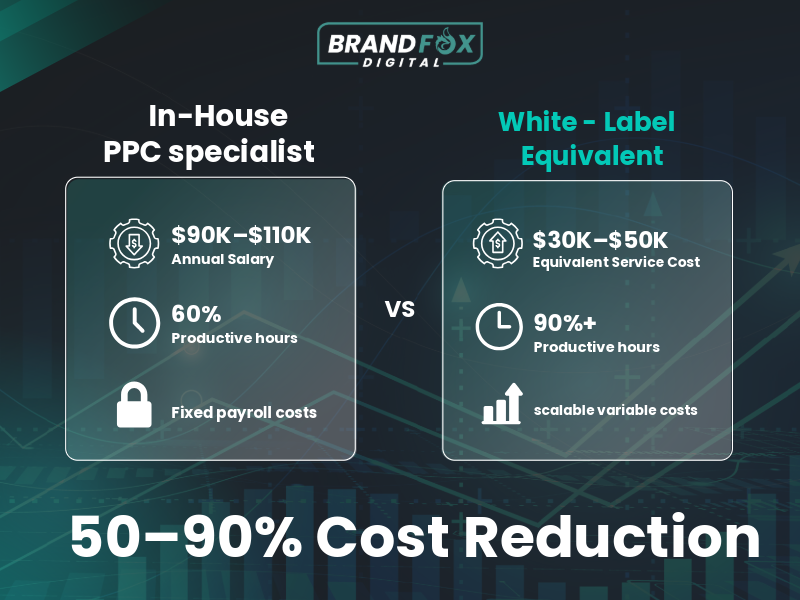
A decent PPC specialist runs $90K–$110K annually when you factor in everything. That same expertise level through a structured white-label partnership? $30K–$50K, depending on scope and volume. The math isn’t complicated.
But here’s where most people get it wrong: they think this is about cutting corners. It’s not. It’s about cutting waste.
The traditional hire spends maybe 60% of their time doing actual work. The rest? Meetings about meetings. Internal admin. The monthly team lunch that somehow takes three hours. Training that could’ve been a document. The white-label specialist? 90%+ productive hours because that’s the entire business model.
This isn’t a theory. Agencies making this shift consistently report 50–90% cost reductions on specific functions while maintaining or improving output quality. The ones who don’t believe this are usually the ones still paying market rate for talent that’s half-utilised.
What Failure Actually Looks Like
The failure mode of outsourcing isn’t usually capability—it’s coordination. The agencies that get burned by white label digital marketing partnerships made one critical mistake: they treated it like traditional outsourcing instead of operational integration.
The good white-label partners figured out years ago that infrastructure, systems, and communication protocols matter more than hourly rates. They built processes that plug directly into agency workflows. They invested in project management that makes the partnership invisible to clients. They hired talent that understands Western client expectations without needing constant hand-holding.
The bad ones? They compete on price alone and wonder why retention is terrible.
What the Smart Money Is Actually Doing
Walk into any successful mid-sized agency, and you’ll find a hybrid model that would’ve seemed bizarre a decade ago.
Client-facing stays local. Strategy and consulting stay local. Anything requiring face-time stays local. But execution? That’s increasingly handled by white-label specialists who do one thing exceptionally well, at a fraction of the cost, without the overhead of being on payroll.
The distinction that matters isn’t “us versus them.” It’s “client-facing versus execution.” Once agencies internalize this, the economics become obvious.
A $500K annual salary bill becomes $200K. A team of six becomes a core team of two plus flexible specialist capacity. Fixed costs become variable. The agency can take on more work without proportional hiring. Or maintain the same revenue with better margins. Or undercut competitors while staying profitable.
The Reality Behind In-House Teams: Ego Often Outweighs Economics
Here’s the uncomfortable truth: most agencies clinging to the “we do everything in-house” line aren’t making a business decision. They’re making an identity decision.
There’s a perceived prestige to having a big team under one roof. It feels more “real.” It looks better in pitch decks. It satisfies some founder’s vision of what an agency should look like.
But clients don’t care about org charts. They care about results, responsiveness, and not getting overcharged for mediocre work.
The agencies winning right now are the ones who killed that ego years ago and rebuilt around a simple question: What’s the most effective way to deliver exceptional results without burning cash on overhead?
Often, the answer involves strategic white label services that let the agency focus on what actually differentiates them—strategy, relationships, industry expertise—while execution gets handled by specialists who live and breathe their specific discipline.
The Evolution Is Just Beginning
What’s happening now is the early stage of a longer trend. As AI tools commoditize tactical execution further, the value of generalist in-house teams drops even more. The future agency is tiny at the core—maybe 3-5 people—with a constellation of specialised partnerships that flex based on client needs.
This isn’t a prediction. It’s already happening. The agencies that haven’t figured this out yet are competing with one hand tied behind their backs, paying 2x for talent that delivers the same output as a well-structured white-label arrangement.
The Australian market is particularly ripe for this evolution. High costs, sophisticated clients, increasing competition, and a time zone that makes Asian partnerships seamless. The agencies that capitalize on this structural advantage will compound their edge year after year. The ones that don’t will keep wondering why their margins are shrinking and their competitors seem to operate at a different cost basis.
What This Means Operationally
Strip away the strategy talk, and here’s what this looks like day-to-day:
An agency lands a new client needing SEO, PPC, and content. Instead of scrambling to hire or overload existing staff, they activate pre-vetted white-label relationships. Work starts immediately. Quality is consistent because the white-label partner has done this exact thing hundreds of times. Costs are predictable and variable. The client gets results without paying for the agency’s learning curve or under-utilized staff.
When the client scales up, capacity scales with it. When they pause a channel, so does the cost. No painful layoffs. No awkward conversations about why the new hire isn’t working out. Just clean, professional execution that looks and feels like it’s coming from the agency itself.
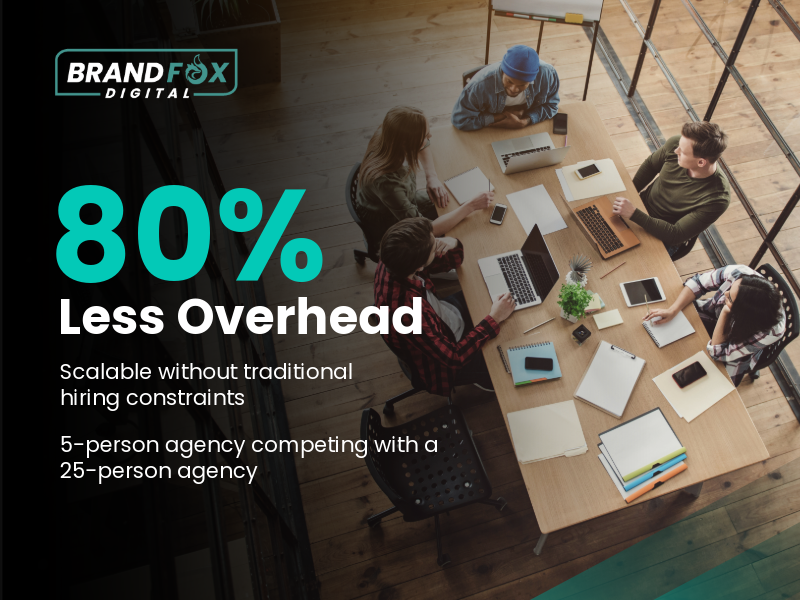
This is the model that lets a 5-person agency compete with a 25-person agency. Same capability, 80% less overhead.
The Bottom Line
The evolution of white-label in digital marketing isn’t about outsourcing anymore. It’s about operational intelligence.
The agencies still treating this as a dirty secret or a cost-cutting measure are missing the point. The smart play is building a core team that owns strategy and client relationships, then surrounding that core with best-in-class specialists who do execution better and cheaper than any in-house hire ever could.
For Australian agencies specifically, the math is almost absurd. A 50–90% cost reduction on core functions, access to specialized talent that would be impossible to hire locally, and the flexibility to scale up or down without the friction of traditional hiring.
The question isn’t whether white label agency models work. They demonstrably do, and the agencies using them are quietly outperforming everyone else. The question is how long it takes for the rest of the market to catch up—and whether holdouts can afford to wait that long.
The agencies making this shift aren’t just cutting costs. They’re building a fundamentally more resilient business model that can compete on value, deliver better margins, and scale without the traditional constraints of headcount and overhead.
That’s not a trend. That’s a structural advantage.
Ready to see what smarter economics look like for your agency? Get in touch to explore how white-label partnerships can transform your cost structure while maintaining the quality your clients expect.